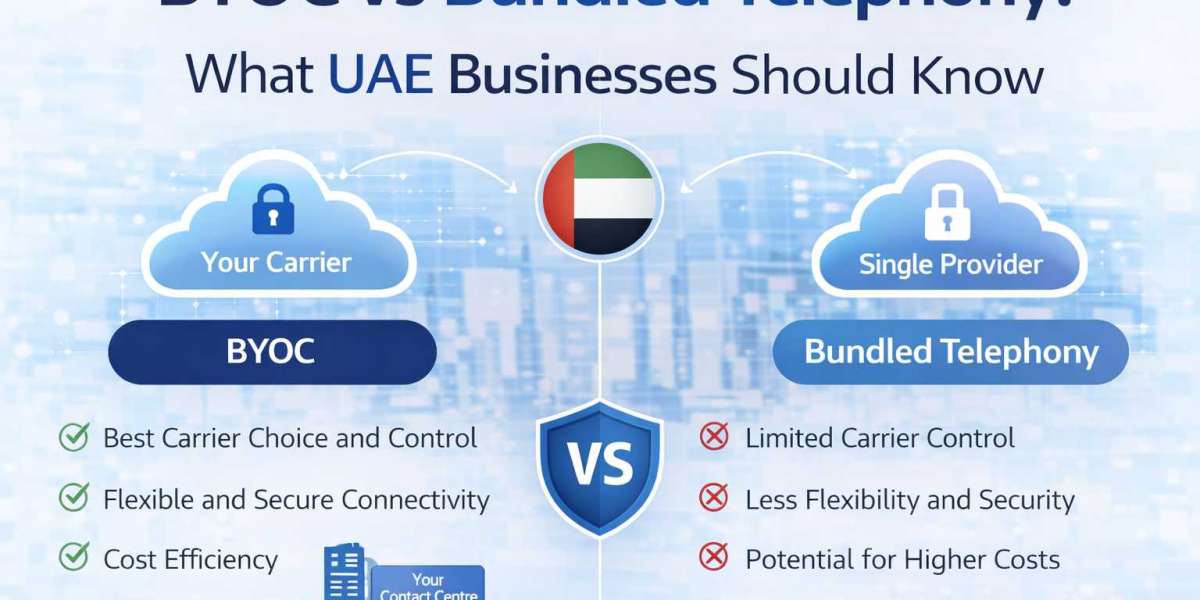

Businesses in the United Arab Emirates are actively upgrading their communication infrastructure to support modern customer engagement. One of the most important decisions companies face is choosing between BYOC (Bring Your Own Carrier) and bundled telephony.
Both models are widely used in cloud communication systems, but they offer different levels of flexibility, control, and cost management. Understanding the difference is essential for organizations planning to implement or upgrade their communication systems.
This guide explains how BYOC and bundled telephony work, their key differences, and which option is more suitable for businesses in the UAE.
What is BYOC (Bring Your Own Carrier)?
BYOC is a communication model where businesses use their own telecom provider while connecting it to a cloud-based platform.
In this setup, the company selects a telecom carrier separately and integrates it with a cloud communication solution. The carrier handles voice connectivity, while the cloud platform manages features such as call routing, analytics, and automation.
This approach gives businesses greater control over pricing, call quality, and compliance.
Platforms like Voiger support BYOC models, allowing organizations to customize their communication systems according to their specific requirements.
What is Bundled Telephony?
Bundled telephony is a model where both the communication platform and telecom services are provided by a single vendor.
In this setup, businesses do not need to choose a separate carrier. The provider offers a complete solution that includes voice services, phone numbers, and cloud-based communication tools.
This model is often easier to implement because everything is managed by one provider. However, it may offer less flexibility compared to BYOC.
Solutions such as CloudTalk typically offer bundled telephony options along with their cloud communication platforms.
Key Differences Between BYOC and Bundled Telephony
The main difference between these two models lies in control and flexibility.
BYOC allows businesses to select their own telecom carrier, giving them more control over pricing and service quality. Bundled telephony, on the other hand, simplifies the process by providing everything through one provider.
BYOC is generally more suitable for businesses with specific compliance requirements or those that want to optimize costs by negotiating directly with carriers.
Bundled telephony is often preferred by businesses that want a quick and simple setup without dealing with multiple vendors.
Flexibility and Control
Flexibility is one of the biggest advantages of BYOC. Businesses can choose carriers based on location, pricing, and performance.
This is especially useful in the UAE, where telecom regulations and service availability can vary. Companies can select local carriers to ensure compliance and maintain service quality.
Bundled telephony offers less flexibility because businesses are limited to the provider’s network and pricing structure.
For organizations that require customized communication systems, BYOC provides a more adaptable solution.
Cost Considerations
Cost is a major factor when choosing between BYOC and bundled telephony.
With BYOC, businesses can negotiate directly with telecom providers and choose cost-effective plans based on their usage.
This can lead to significant savings, especially for companies with high call volumes or international operations.
Bundled telephony typically includes fixed pricing, which may be convenient but not always the most cost-efficient option.
Businesses should evaluate their communication needs carefully to determine which model offers better value.
Compliance and Regulations in the UAE
Telecommunications in the UAE are regulated, and businesses must comply with local requirements when setting up communication systems.
BYOC allows companies to work with approved local carriers, making it easier to meet regulatory standards.
This is particularly important for industries such as finance, healthcare, and government services.
Bundled telephony providers may not always offer the same level of control over carrier selection, which can create challenges in certain compliance scenarios.
Integration with Modern Communication Solutions
Both BYOC and bundled telephony can integrate with modern communication systems, but the level of customization differs.
BYOC works well with advanced solutions such as AI call centre UAE, AI voice bot UAE, and Call routing software UAE, allowing businesses to create tailored workflows.
It also supports integration with tools like Call tracking software UAE and CRM systems, which are essential for performance monitoring and customer management.
Bundled telephony also supports these features, but customization options may be limited depending on the provider.
Scalability for Growing Businesses
Scalability is another important factor to consider.
BYOC allows businesses to scale their communication systems by adding new carriers or expanding existing ones without changing the entire infrastructure.
This is particularly useful for companies that operate across multiple regions.
Bundled telephony systems are also scalable, but expansion is usually limited to the provider’s capabilities.
For businesses planning long-term growth, BYOC may offer more flexibility.
Use Cases for BYOC in the UAE
BYOC is commonly used by enterprises that require high levels of customization and control.
Large organizations with multiple offices often use BYOC to connect different carriers across regions while managing communication through a centralized platform.
Industries with strict compliance requirements, such as banking and healthcare, also prefer BYOC because it allows them to work with approved telecom providers.
Use Cases for Bundled Telephony
Bundled telephony is often used by small and medium-sized businesses that prefer a simple and quick setup.
Startups and companies with limited technical resources may find bundled solutions more convenient because they do not require managing multiple vendors.
Solutions designed for Call centre for SMB UAE often include bundled telephony to simplify implementation.
Challenges to Consider
Both models come with their own challenges.
BYOC requires technical expertise to integrate carriers with cloud platforms. Businesses may also need to manage relationships with multiple vendors.
Bundled telephony, while simpler, may limit flexibility and increase costs in the long term.
Organizations should evaluate their technical capabilities, budget, and operational needs before choosing a model.
How to Choose the Right Option
Choosing between BYOC and bundled telephony depends on several factors.
Businesses that require flexibility, cost control, and compliance should consider BYOC.
Companies that prioritize simplicity and quick deployment may prefer bundled telephony.
It is also important to consider integration with existing systems such as Call centre software UAE, Cloud call centre software UAE, and Business phone system UAE.
Evaluating these factors will help businesses select the most suitable communication model.
Frequently Asked Questions
What is the main difference between BYOC and bundled telephony?
BYOC allows businesses to use their own telecom carrier, while bundled telephony provides both the platform and carrier services through one provider.
Which option is better for UAE businesses?
It depends on business needs. BYOC is better for flexibility and compliance, while bundled telephony is suitable for quick and simple setups.
Is BYOC more cost-effective?
In many cases, yes. Businesses can negotiate pricing directly with carriers, which can reduce communication costs.
Can small businesses use BYOC?
Yes, but they may need technical support for integration. Many small businesses prefer bundled solutions for simplicity.
Do both options support cloud communication features?
Yes. Both BYOC and bundled telephony support modern features such as automation, analytics, and integration with business tools.
Conclusion
Businesses in the United Arab Emirates must carefully evaluate their communication needs when choosing between BYOC and bundled telephony. Each model offers unique advantages depending on the level of flexibility, control, and simplicity required.
BYOC provides greater customization, cost control, and compliance support, making it suitable for enterprises and organizations with complex requirements. Bundled telephony offers convenience and faster implementation, making it ideal for smaller businesses or those looking for a straightforward solution.
By understanding these differences and aligning them with business goals, companies can build efficient communication systems that support long-term growth and customer engagement.